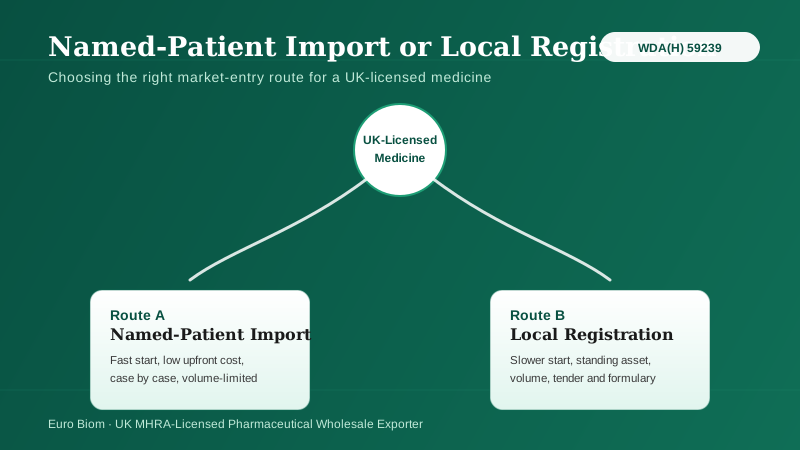
A distributor, hospital group or manufacturer's local partner has a UK-licensed medicine it wants into a market where that medicine is not yet locally registered. That is a common, unremarkable starting point. What is less well understood is that there are two genuinely different routes from there, not one, and the choice between them shapes cost, speed, volume and how durable the resulting supply arrangement is. This is not an explainer of what named-patient supply is, or what registration is. It assumes the reader already knows both. What follows is a working framework for choosing between them, and for understanding the sequence most successful entrants actually use.
To be clear about where Euro Biom sits in this picture: we are a UK MHRA-licensed wholesale exporter, WDA(H) 59239, supplying UK-licensed, MHRA-authorised finished medicines. We are not a manufacturer, not a regulatory consultancy, and we do not hold foreign registrations or import permissions ourselves. Everything below describes the buyer's decision and the buyer's local partner's regulatory position. Our part is supplying the UK-licensed product and the documentation set that supports whichever route the buyer takes.
Two Routes, One Decision
Almost every destination market recognises two broad mechanisms for bringing in a medicine that is authorised somewhere else, in this case the UK, but is not registered locally. The first is import under the country's own named-patient, special-access or unregistered-medicine provisions, which authorises a specific patient, cohort or consignment. The second is full local product registration, which grants the product itself a standing marketing authorisation held by a local entity, after which it can be sold, stocked, tendered and prescribed like any other registered medicine in that market.
Both routes require the same starting point: a genuine, UK-licensed, MHRA-authorised finished medicine, with a manufacturer operating under MHRA GMP oversight and a Certificate of Pharmaceutical Product available on request. What differs is entirely on the destination side, in how the buyer's market treats that product once it arrives, and what obligations and permissions the buyer's local partner takes on. Getting this choice right at the outset, rather than defaulting into whichever route someone happened to use last time, is the difference between a market entry that scales cleanly and one that stalls.
Route A: Named-Patient or Special Import
Named-patient and special-access import exists in some form in nearly every regulated market, precisely because no formulary can cover every product a patient might need. Commercially, it behaves in a distinctive way.
- Fast to start. There is no dossier to compile and no multi-month review of a registration file. A first shipment can typically move once the destination country's own paperwork, a prescription, an import authorisation or an equivalent instrument, is in place.
- Low up-front cost. There is no registration fee, no local clinical or bridging study, and usually no requirement to establish a full local regulatory presence before the first supply.
- Higher unit cost. Smaller, ad hoc consignments rarely benefit from the freight, customs and administrative economies of scale that a registered, tendered product enjoys.
- Administrative burden repeats. Each patient, cohort or shipment typically needs its own permission, prescription or import authorisation. This does not disappear after the first success, it recurs with every case.
- Volume ceilings. Most regulators design this route for individual or small-cohort need. Pushed toward high, sustained volume, it tends to slow down, attract additional scrutiny, or simply become the wrong tool for the job.
- No marketing rights. There is no formulary listing, no tender eligibility, and no standing local presence for the product. Every supply event is its own case.
Our named-patient supply page sets out how the UK side of this route works in practice, and what documentation typically accompanies each consignment.
Route B: Full Local Product Registration
Registration is the slower, more expensive route to start, and the more durable one to hold.
- Slow and expensive to start. A registration dossier, usually in Common Technical Document format, has to be compiled and submitted, and in most markets a locally established marketing authorisation holder or authorised representative has to be appointed before submission is even possible.
- A local applicant or agent is required. The dossier is submitted, and the resulting authorisation is held, by a local entity, not by the UK manufacturer or exporter directly.
- Volume and predictability follow. Once granted, the product can be stocked routinely, priced within the local regulated framework, and supplied without a fresh permission for every case.
- Tender and formulary access. Registration is usually a precondition for participating in government or hospital-network tenders and for formulary or reimbursement listing, both of which are closed to unregistered products regardless of clinical need.
- Durability. A registration is a standing asset. Once held, it does not need to be re-earned for every shipment, and it underpins long-term local presence in a way a case-by-case permission cannot.
For the documentation a UK-licensed product typically needs to support a registration dossier, see our guide to UK pharmaceutical import documentation, and for how registration requirements differ market by market, the regulator comparison tool is a useful starting reference.
Comparing the Two Routes
The table below sets out the same decision criteria side by side. It is deliberately general, since exact rules vary by country and product class, but the pattern holds across most regulated markets Euro Biom supplies into.
| Criterion | Named-Patient / Special Import | Full Local Registration |
|---|---|---|
| Time to first supply | Weeks, once destination paperwork is in place | Typically many months, sometimes longer |
| Up-front cost | Low, no dossier or registration fee | Higher, dossier preparation, fees and a local applicant |
| Cost per unit | Higher, smaller consignments, less economy of scale | Lower once volume is established |
| Volume ceiling | Designed for individual or small-cohort need | No inherent ceiling once registered |
| Documentation burden | Repeats with every patient or shipment | Front-loaded into the dossier, then largely settled |
| Who holds the permission | Prescriber, hospital or importer, case by case | Local marketing authorisation holder, standing |
| Tender or formulary eligibility | Generally not available | Usually a precondition |
| Durability | Renewed or repeated each time | Standing asset once granted |
The practical read: named-patient import optimises for speed and low commitment. Registration optimises for scale and permanence. Neither is universally better, they answer different questions.
When Named-Patient Import Is the Right Call
Named-patient import is the genuinely correct answer, not a compromise, in several recurring situations.
- Small or rare patient populations. Where the addressable patient count in a market is a handful of cases a year, a registration dossier will rarely pay for itself, and a case-by-case route matches the actual clinical need.
- Urgent or intermittent need. When a hospital needs a specific medicine now, for a patient in front of them, waiting for a multi-month registration process is not a realistic option.
- Testing demand before committing capital. Before investing in a dossier, a local applicant and registration fees, a distributor can use named-patient supply to establish that real, recurring demand exists.
- A bridge while registration is in progress. Registration dossiers take time to review. Named-patient import can keep patients supplied with the same product during that window, rather than leaving a gap.
For the operational side of moving quickly on urgent cases, see our pages on emergency pharmaceutical supply and drug shortage supply.
When Registration Is the Right Call
Registration earns its cost when the commercial picture looks different.
- Sustained, predictable volume. Where demand is consistent rather than sporadic, the lower unit cost and reduced per-shipment administration of a registered product outweigh the up-front investment.
- Tender participation. Government and hospital-network tenders in most markets require registration as a precondition. Without it, a product cannot compete for that business at all, regardless of clinical merit.
- Formulary or reimbursement inclusion. Where a national or institutional formulary is the route to routine prescribing and reimbursement, registration is usually the gate.
- Long-term market presence. A distributor or manufacturer's partner planning a multi-year commitment to a market benefits from the standing, renewable nature of a registration rather than repeated case-by-case permissions.
The Hybrid Route Most Successful Entrants Actually Use
In practice, the sharpest distributors and hospital groups rarely pick one route and stay there. The pattern that recurs across markets Euro Biom supplies into is sequential, not exclusive: start on named-patient import to establish clinical demand and prove that the supply chain, documentation and cold-chain handling work reliably, then move to full registration once the volume case is proven.
This bridge does real work in both directions. It protects the local partner from registering a product speculatively, before anyone knows whether real demand exists, and it protects patients from a gap in supply while a registration dossier works through review. It also generates the evidence, actual prescriptions, actual consumption, actual outcomes, that strengthens a registration submission when it is eventually filed, because the applicant is no longer arguing demand exists, they are demonstrating it. Where a product's registration is already in progress, named-patient supply of the same UK-licensed product is often the most direct way to keep patients covered without waiting for the dossier to clear.
This is the single most useful reframing in this whole comparison: named-patient import and registration are not competing options to choose between once. For most products that eventually reach volume, they are two stages of the same market entry.
Who Holds What: Documentation and Responsibility
It matters to be precise here, because the two roles are easy to blur. In almost every destination market, whichever route is used, the local agent, importer, hospital pharmacy or marketing authorisation holder is the party that holds the registration or the import permission. That local entity submits the dossier or the named-patient application, manages the relationship with the destination regulator, and carries the in-country regulatory obligations. A UK supplier does not hold that permission, and should not represent that it does.
What the UK side supplies, in either route, is the product itself and the evidence behind it: a genuine UK-licensed, MHRA-authorised finished medicine, a Certificate of Pharmaceutical Product confirming that licensed status, current GMP evidence for the manufacturing site, a batch release certificate and batch documentation for the specific consignment, and, where the local partner's process requires it, a letter or evidence confirming the exporter's own Wholesale Dealer Authorisation. See our WDA licence page for what that authorisation covers, and our compliance page for the wider Good Distribution Practice framework it sits within.
Documentation quality is not a formality in either route. A named-patient application that arrives with an incomplete or inconsistent document set is delayed exactly like a registration dossier with the same problem, just on a shorter cycle that repeats more often. Getting the UK-side paperwork right on the first submission is what keeps either route moving at a predictable pace.
How Euro Biom Supports Either Route
Whichever route a buyer chooses, Euro Biom's role is the same: supplying a genuine UK-licensed, MHRA-authorised finished medicine, sourced and despatched under WDA(H) 59239 and full Good Distribution Practice, with the documentation the buyer's local partner needs to make their application, whether that is a single named-patient shipment or the evidence base for a registration dossier. We work with hospital pharmacies, Ministry of Health buyers, NGOs, and licensed distributors and their local representatives across the GCC, Africa, Turkey, the Levant and CIS and Asia. If your organisation is qualifying a new UK supply line before choosing a route, our supplier qualification page covers what we can provide for that assessment. For a wider view of how the UK-licensed product itself fits either pathway, our services overview and import documentation guide are useful next reads.
Weighing named-patient import against registration for a specific product and market? Contact our team at work@eurobiom.co.uk or via the enquiry form. We respond to all enquiries within one working day, and urgent or shortage requests within four hours.
Frequently Asked Questions
Choosing a Market-Entry Route?
Talk to our team about UK-licensed supply, documentation and how it fits either a named-patient or registration pathway. We respond within one working day.
Submit an Enquiry