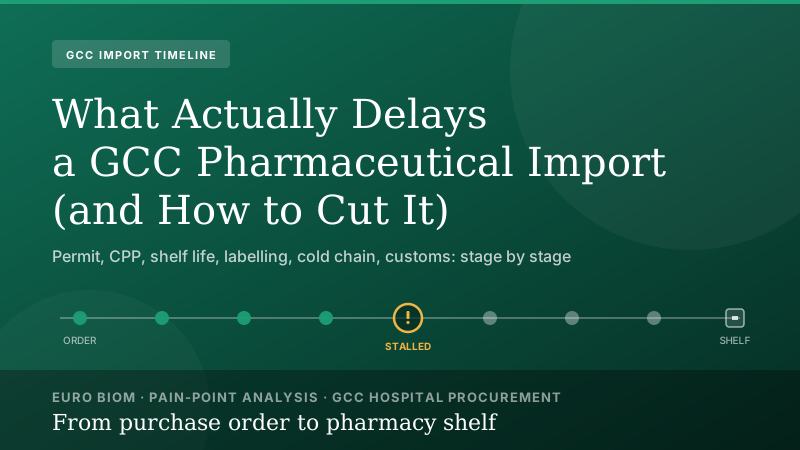
A GCC hospital order for UK-licensed medicines rarely stalls at the point everyone planned for. The product is registered, or the named-patient route is agreed; the tender is awarded; the supplier is qualified. The consignment still sits in the bonded store at the destination airport while someone chases a document that should have been correct before dispatch. Across Saudi Arabia, the UAE, Qatar, Kuwait, Bahrain and Oman, delays commonly come from small mismatches between permits, documents, batches and packs, not from the regulatory frameworks themselves.
This article walks a consignment from purchase order to pharmacy shelf and names the step that actually stalls at each stage, who owns it, and how to stop it. It does not re-explain each regulator's registration process; for that, see our guides to SFDA registration, MOHAP import permits and the Qatar MOPH process, and the GCC export overview.
For transparency: Euro Biom Ltd is a UK MHRA-licensed pharmaceutical wholesale exporter, WDA(H) 59239, supplying only UK-licensed, MHRA-authorised finished medicines. We prepare the export-side documentation and dispatch via London Heathrow. The import permit, the customs entry and the in-market release sit with the licensed importer and the receiving hospital.
The Short Answer
- Much avoidable delay is created before dispatch, when the import permit, the CPP, the invoice and the physical pack do not describe the same product. Pack size, strength and the licence holder on the pack are the usual culprits.
- A further common source is a batch that is saleable in the UK but has less remaining shelf life than the regulator or hospital accepts, discovered at the receiving bay rather than at quotation.
- Another is cold-chain evidence that cannot be produced on demand at the port: a logger that was never started, a serial number missing from the paperwork, a packaging qualification nobody can find.
- Customs valuation and QA release are rarely the root cause themselves, but they are where the earlier errors surface, because the broker and the pharmacist are the first people to compare every document against the goods.
- The fix is to lock one product description (brand, generic name, strength, form, pack size, pack count, UK licence number, licence holder, minimum remaining shelf life, storage condition) at quotation and repeat it unchanged on every document that follows.
Nine stages, several owners. The table shows where each stage normally breaks; the sections below take them in order.
| Stage | Owner | What typically stalls it |
|---|---|---|
| 1. Purchase order and quotation | Buyer, with the UK supplier confirming | Order placed against a product description the permit will not match |
| 2. Import permit | Licensed importer | Permit issued for the wrong pack size, strength or licence holder; validity consumed while documents are legalised |
| 3. CPP and export documents | UK supplier, via the MA holder and the MHRA | Wrong certificate type, not legalised, or the MA holder on the certificate differs from the pack |
| 4. Batch allocation | UK supplier | Remaining shelf life below the regulator's or hospital's threshold |
| 5. Labelling and leaflet | Importer or local MA holder, checked by the UK supplier | Arabic text required and absent, or responsibility for it never assigned |
| 6. Cold-chain pack-out | UK supplier and forwarder | Logger file, serial number or packaging qualification not available |
| 7. Airline booking and uplift | Forwarder | Not booked as temperature-sensitive cargo; no pharma handling at the destination airport |
| 8. Customs clearance | Importer and its broker | Invoice value, HS code or authentication does not match the permit |
| 9. Receiving and QA release | Hospital pharmacy | Logger cannot be read; packing list does not show batch per carton |
Stage 1: The Purchase Order Fixes Everything That Follows
Every downstream document repeats the purchase order: permit application, CPP request, commercial invoice, packing list, air waybill and customs entry. If the order says only "Product X 500 mg tablets, 1,000", the first question is whether that means tablets or packs, and the second is which pack. UK presentations of the same medicine can exist in packs of 28 and 30, from more than one licence holder, and the permit will have to name one of them.
The parallel import point is the one most often missed. Product supplied under a UK Parallel Import Licence (a PLPI number rather than the originator's PL number) is UK-licensed and MHRA-authorised, but the licence holder printed on the outer pack is the parallel importer, not the originator. If the importer raised its permit against the originator's details, the inspector at the port is looking at a pack that does not match. That is a description problem, not a quality problem, and it is avoidable at quotation.
Owner: the buyer, with the UK supplier confirming each line. Prevention: treat the supplier's pro forma invoice, not the tender line, as the source document for everything that follows. It should carry, per line, brand and generic name, strength, form, pack size, number of packs, UK licence number, licence holder as printed on the pack, storage condition and the minimum remaining shelf life required. Euro Biom quotes in exactly this form and confirms batch number and expiry before dispatch.
Stage 2: The Import Permit That Describes a Different Pack
The permit belongs to the licensed importer in the destination market, and in the GCC markets it is typically a per-consignment instrument rather than a standing approval, as the UAE example below shows. The UAE example is the most clearly documented. MOHAP's service for the import of medicines through a local agent is a two-stage process: an initial approval applied for before the goods leave the country of origin, valid for 60 days while the shipment is prepared, followed by a separate shipment clearance application once the air waybill exists. The clearance permit is likewise valid for 60 days and release to the local market depends on the ministry inspector's approval at arrival, according to MOHAP's published service description.
Saudi Arabia, Qatar, Kuwait, Bahrain and Oman each run their own equivalent; the SFDA, for instance, has its own shipment clearance process for registered products, and the importer should confirm the current steps. The mechanics differ, the failure mode does not: the permit is issued against a product description, and the consignment must match it.
Where it stalls
- Permit raised for the originator's pack; a parallel import pack is shipped.
- Strength or pack size transcribed from an approximate tender line.
- Quantity on the permit in units, on the invoice in packs.
- The 60-day initial approval expires while documents are legalised, and the application is refiled.
Owner: the licensed importer. Prevention: apply for the permit from the supplier's pro forma, after the licence holder question is settled. Sequence the permit against the document chain so that validity is not consumed waiting for a consular stamp; our article on legalisation and attestation sets out realistic timings. Where a named-patient or special import route is used for a UK-licensed product not registered locally, confirm the permit names that route, because the inspector expects a different document set.
Stage 3: The CPP, Its Format and the Name on the Pack
Most GCC regulators expect a Certificate of a Pharmaceutical Product for a UK-licensed medicine, and it is the document most often returned for rework. Two things commonly go wrong, and for a basket from several manufacturers the permission letters multiply.
Wrong certificate type or format. GOV.UK's guidance on exporting medicines notes that the certificate type needed depends on the importing country's requirements, and that for a licensed product the application to the MHRA must be accompanied by a letter on the marketing authorisation holder's headed paper giving permission to export on its behalf, either for a specific product or as an open authorisation, according to GOV.UK. The certificate for a licensed product states the marketing authorisation holder, the active ingredients and excipients, the manufacturing, packaging and batch release sites, and whether the product is currently on the UK market. If the regulator wants a WHO-format certificate with consular legalisation and receives a scan of an unlegalised one, the consignment waits.
The MA holder on the CPP does not match the pack. The certificate names the UK marketing authorisation holder. If the pack shipped is a parallel import, the licence holder on the pack is a different company, and the inspector will ask why. The same happens when an authorisation has transferred between companies and older packs are still in the supply chain.
Owner: the UK supplier, coordinating with each MA holder and the MHRA; the importer specifies what its regulator will accept. Prevention: confirm at quotation which certificate type and legalisation level the regulator requires, and that the licence holder on the CPP will match the pack that ships. Our import documentation guide lists the full document set, and the import requirements checker gives a market-by-market starting point.
The document-to-pack rule. Before dispatch, the same fields (brand, generic name, strength, form, pack size, UK licence number and licence holder) should read identically on the import permit, the CPP, the commercial invoice, the packing list and the physical outer pack. A single mismatch can be enough to hold a consignment at the port, and it is far cheaper to catch on a pro forma.
Stage 4: Remaining Shelf Life: Legal in the UK, Refused at the Port
UK wholesale stock is managed for the UK market, where a product with nine months left on a three-year shelf life is entirely saleable. GCC regulators and hospitals apply a different test, and it is usually stricter than buyers expect.
Qatar's Ministry of Public Health, through its Department of Pharmacy and Drug Control, issued circular PDC/2026/07 requiring imported medicines to have at least two-thirds of their shelf life remaining on entry into the country, with exemptions only by prior approval from the department, as reported by Marhaba in April 2026. For a 36-month product, that means at least 24 months remaining on the day it lands in Doha. We have not found a single published SFDA percentage for the remaining shelf life of imported medicines, so confirm the current Saudi requirement with the licensed importer before quotation. Hospital pharmacies commonly add their own threshold in months, and a hospital that rejects a batch at the receiving bay is within its contract.
Owner: the UK supplier selects the batch; the buyer sets the requirement; the importer applies for any exemption. Prevention: put the minimum remaining shelf life in months on the purchase order, not a vague "long-dated". The supplier confirms batch number and expiry against that figure before dispatch, which Euro Biom does as standard. Where only a shorter-dated batch exists, the importer applies for an exemption before the goods ship, with the expiry date in hand.
Stage 5: Arabic Labelling and the Leaflet
The SFDA's guidance for labelling, Summary of Product Characteristics and Patient Information Leaflet, requires the applicant to provide an Arabic translation for the labelling components listed in its Appendix 1, and notes in that appendix that the requirement is not applicable for medicines used solely in hospitals, according to the SFDA guidance document. For registered products the SFDA's labelling and leaflet requirements, including any bilingual leaflet and e-labelling provisions, should be confirmed against its current guidance with the importer. A UK pack carries English-only labelling and an English leaflet.
For a registered product, the local marketing authorisation holder normally owns the Arabic artwork or over-labelling arrangement. The consignments that stall are named-patient or special imports of a UK pack where nobody has asked whether English-only labelling is acceptable for that route, that regulator and a hospital-only product. The inspector asks on arrival instead.
Owner: the importer or the local MA holder; the UK supplier checks that what it ships matches what was agreed. Prevention: settle at permit stage whether Arabic labelling applies, who provides it, and where it is applied. Relabelling a UK pack is not a wholesale activity and is not something Euro Biom does; where over-labelling is needed, it is carried out in-market by a licensed party. If English-only is accepted for a hospital-use product on a named-patient permit, get that in writing before dispatch.
Stage 6: Cold-Chain Evidence That Cannot Be Produced on Demand
Chapter 9.2 of the EU Good Distribution Practice guidelines, which the MHRA applies, states that the required storage conditions for medicinal products should be maintained during transportation, as quoted in an MHRA Inspectorate post on transport risk. The same post makes the point that matters here: it is rare to find sound scientific justification for accepting a load that has had a temperature excursion, and the most common reason such loads are accepted is commercial. If the evidence is weak, the right answer is usually rejection, so the evidence had better be strong.
Port inspectors and hospital QA teams may ask to see that evidence on arrival, and requirements differ by market, so agree with the importer what its receiving authority expects before dispatch.
Where it stalls
- The logger was packed but never started, or started after the shipper was sealed.
- The serial number is missing from the packing list and invoice, so the record cannot be tied to the consignment.
- The record exists only in a proprietary format nobody at the port can open.
- The passive shipper's qualification (its tested hold time at a defined ambient profile) cannot be produced, or the profile bears no relation to a Gulf tarmac in August.
- An alarm fires and there is no agreed procedure for who assesses it, with what data, and who has authority to release or reject.
Owner: the UK supplier for pack-out and the record; the forwarder for the handling in between; the importer and hospital for the assessment on arrival. Prevention: one logger per shipper, started before sealing, serial number on the packing list and invoice, a PDF export emailed on dispatch with the raw file, the packaging qualification summary available on request, and an excursion procedure agreed at quotation. Our cold-chain export to the Middle East page covers the 2-8°C pack-out and lane in more detail.
Stage 7: The Airline Booking and the Tarmac
The International Air Transport Association's Temperature Control Regulations make the Time and Temperature Sensitive label compulsory on shipments booked as such, a requirement that has applied since 1 July 2012, according to an IATA information notice published by Pharmaceutical Online. Carriers add their own acceptance conditions. Airline pharma programmes commonly require the temperature range on the label to match the air waybill, allow only one temperature range per air waybill, and ask for a 24-hour emergency contact on the air waybill, so check the carrier's own pharmaceutical handling terms before booking. IATA's own programme material recommends that airlines, forwarders and ground handlers hold CEIV Pharma certification to support GDP compliance, per the IATA pharma programme.
The failure here is rarely the aircraft. It is the booking and the ground. A 2-8°C consignment booked as general cargo loses its handling priority. Ambient and refrigerated lines on one air waybill give two temperature ranges where carriers want one. And the destination matters as much as Heathrow: whether the arrival airport's ground handler has a temperature-controlled pharma facility, and whether the consignment lands while the importer's broker and the regulator's port unit are working. Working weeks differ across the six GCC markets and from the UK, and a consignment that arrives at the start of a local weekend sits.
Owner: the forwarder, briefed by the UK supplier and the importer. Prevention: book the forwarder's pharma product rather than general cargo, split ambient and 2-8°C lines across air waybills if the carrier requires it, confirm the destination cold room before booking, and time the uplift so arrival falls inside the importer's clearance hours. Because the UAE shipment clearance application needs the air waybill, the importer should receive it the moment it is issued.
Stage 8: Customs Valuation, HS Code and the Importer's Clearance
Finished medicines in measured doses or retail packs fall under heading 3004 of the Harmonised System, which the UK Trade Tariff describes as medicaments consisting of mixed or unmixed products for therapeutic or prophylactic uses, put up in measured doses or in forms or packings for retail sale, subdivided by active ingredient class from 3004.10 to 3004.90. The code itself seldom causes trouble; the invoice around it does.
Where it stalls
- The invoice value differs from the pro forma the permit was issued against, often because freight or a currency conversion was added later.
- Free-of-charge or replacement goods shipped at zero value, which some customs authorities will not accept as a valuation.
- The invoice is not authenticated where the importer's regulator or customs authority requires it (chamber of commerce authentication, for example), because nobody asked at quotation.
- Incoterm and currency missing, so the broker cannot build the customs value.
- Batch numbers on the packing list do not reconcile to the cartons, so physical inspection takes longer.
Owner: the importer and its customs broker; the UK supplier issues the invoice and packing list in the form they need. Prevention: issue the commercial invoice once, matching the pro forma line for line, with Incoterm, currency, unit price, HS code, country of origin and UK licence number per line, and batch and expiry on the packing list per line and per carton. Build chamber authentication and any consular legalisation of the invoice into the same timeline as the CPP.
Stage 9: The Receiving Bay and QA Release
The last stage is the hospital's own: goods received, documents matched to cartons, logger downloaded, batch and expiry checked against the order, stock in quarantine until the pharmacist releases it. None of this should take long, and when it does, it is because something upstream was left for the receiving bay to discover.
The avoidable version: the consignment is received by general goods-in rather than pharmacy, nobody has the software to read the logger, the packing list shows a total but not which batch is in which carton, two batches of one product arrive undeclared, and the outer cartons show damage with no dispatch photographs to compare against.
Owner: the hospital pharmacy, with the importer handing over. Prevention: name a pharmacy receiving contact on the order, send the logger file and dispatch photographs on dispatch day so QA can pre-review, and insist on a packing list with batch and expiry per line and per carton. A supplier that confirmed batch and expiry before dispatch has already given QA most of what it needs.
Pre-Shipment Checklist
Everything here can be confirmed before the airline booking is made. If any line is open, the booking is premature.
| Item | Owner | Confirmed before |
|---|---|---|
| Product description locked per line, including pack size, UK licence number and licence holder on pack; parallel import packs accepted or excluded in writing | Buyer and UK supplier | Permit application |
| Import permit issued against the pro forma, with validity dates noted | Licensed importer | CPP application |
| Certificate type and legalisation level specified by the importer's regulator | Importer | CPP application |
| Licence holder on CPP matches licence holder on pack | UK supplier | Dispatch |
| Minimum remaining shelf life stated in months; batch and expiry confirmed against it, or an exemption applied for | Buyer sets; UK supplier confirms | Dispatch |
| Arabic labelling requirement settled for this route, and who applies it | Importer or local MA holder | Permit application |
| Logger serial number on packing list and invoice; export format agreed | UK supplier | Dispatch |
| Packaging qualification summary and excursion procedure available | UK supplier | Quotation |
| Booked as temperature-sensitive cargo; one temperature range per air waybill; destination cold room confirmed; air waybill sent to the importer on issue | Forwarder | Booking |
| Commercial invoice matches pro forma; Incoterm, currency, HS code, origin and authentication in place | UK supplier and importer | Dispatch |
| Pharmacy receiving contact named; logger file and dispatch photographs sent on dispatch day | UK supplier and hospital | Arrival |
Where Euro Biom Fits
Euro Biom works on the export side of this timeline. For UK-licensed medicines, we quote line by line with the full pack description, confirm batch number and expiry before dispatch against the shelf life specified, coordinate the CPP application and the marketing authorisation holder's permission letter, issue the invoice and packing list in the form the importer's broker needs, arrange 2-8°C pack-out under GDP, through the licensed supply chain, with a started logger whose serial number is on the paperwork, and dispatch via London Heathrow on the forwarder's pharma product. Our Saudi Arabia, UAE and Qatar pages describe the export routes into each market.
What we do not do matters for planning. We do not hold the import permit, clear customs or relabel packs; product is sourced through the UK licensed supply chain for each order rather than from storage of our own. We supply only UK-licensed, MHRA-authorised finished medicines, and our scope does not include unlicensed medicines or specials, vaccines, biologics, biosimilars, insulin, blood or plasma products or controlled drugs. Where a UK-licensed product is not registered in your market, the named-patient or special import route is yours to hold and ours to document; see our named-patient supply page.
Related reading: Document legalisation and attestation · MOHAP import permits UAE 2026 · SFDA drug registration for UK exporters · UK import documentation guide
Frequently Asked Questions
Planning a GCC Consignment?
Send us the product list, the destination market and the shelf life your hospital requires. We will quote line by line with the full pack description, so the permit can be raised against it.
Submit an Enquiry