Most conversations about what delays a pharmaceutical export focus on customs, on cold chain, or on the destination regulator's own approval process. In practice, a quieter and far less discussed step causes just as much slippage: getting a UK-issued document legalised and attested so that a destination country will actually accept it as genuine. Buyers and their local agents are frequently surprised to learn that a perfectly valid Certificate of a Pharmaceutical Product, correctly issued by the MHRA, is not automatically usable overseas. It first has to pass through a chain of verification, and that chain has its own sequence, its own working-day timelines, and its own well-worn list of ways to go wrong.
This guide sets out how that chain works for UK-origin pharmaceutical export documents, what realistic timing looks like, which documents typically need it and which usually do not, and the specific mistakes that most often send a document back for rework. It also explains, plainly, what Euro Biom does and does not do in this process, because getting that distinction right matters as much as the paperwork itself.
Legalisation delays are unusually easy for a buyer to miss during planning, precisely because they do not show up as a line item anywhere. There is no customs hold notice, no regulator rejection letter with a case number. What actually happens is that a document sits in a queue, first with a solicitor or notary, then with the Foreign, Commonwealth and Development Office, then with an embassy, while the rest of the shipment is otherwise ready to move. Because those queues are measured in working days rather than hours, and generally run in sequence, a chain that looks simple on paper can add a meaningful stretch of calendar time to an order everyone assumed was close to dispatch. The problem compounds when legalisation is treated as an afterthought, started only once the goods are packed. By then, every day spent waiting for a stamp is a day the medicines are not moving, even though nothing about the medicines themselves is holding things up.
What Legalisation Actually Is, and Why Destination Regulators Demand It
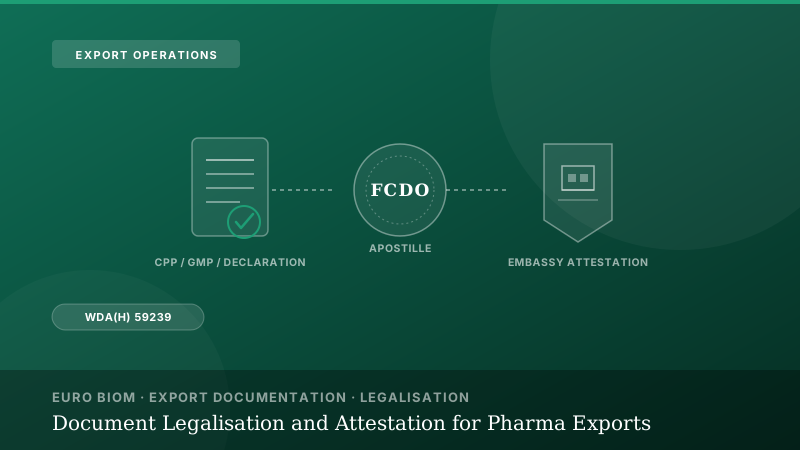
Legalisation is best understood as a chain of official verification. A destination country's ministry of health, customs authority or hospital procurement office has no direct way of confirming that a certificate bearing an MHRA stamp, a solicitor's signature or a company director's countersignature is genuine. Legalisation solves that problem by having each link in the chain vouch for the one before it: a solicitor or notary certifies that a signature is genuine, the FCDO certifies that the solicitor or notary is who they claim to be and is entitled to certify documents, and, where required, the destination country's own embassy certifies that the FCDO's certification is itself genuine. By the time a document reaches the destination regulator, it carries a verifiable, government-backed chain of custody that does not depend on anyone overseas being able to pick up the phone and call the UK issuer directly.
This matters most for the documents that carry the most regulatory weight: a Certificate of a Pharmaceutical Product, a free sale certificate, a GMP certificate, or a signed manufacturer declaration. Several of these originate with the MHRA or with the manufacturer rather than with the wholesaler moving the goods, which is an important distinction covered further below.
The Typical Sequence for a UK Pharmaceutical Export Document
While the exact order can vary by document type and by destination, a fairly consistent pattern applies to most UK-origin pharmaceutical export documents that require full legalisation:
- Issue of the original document. A Certificate of a Pharmaceutical Product or a free sale certificate is issued by the MHRA, a GMP certificate is issued by or on behalf of the manufacturing site, and a manufacturer declaration or commercial document is issued and signed by the relevant company.
- Solicitor or notary certification, where required. A solicitor or notary public certifies that a signature on the document, or a copy of it, is genuine. Not every document needs this step; it depends on the document type and what the destination country expects.
- Chamber of commerce certification, in some cases. For certain commercial documents, such as invoices or certificates of origin, certification by a chamber of commerce is obtained before the document proceeds to FCDO legalisation.
- UK FCDO legalisation, the apostille. The Foreign, Commonwealth and Development Office applies its apostille certificate, confirming that the signature, seal or stamp on the document is genuine and that the person or body that issued it was authorised to do so.
- Embassy or consulate attestation of the destination country. For many non-Hague-Convention destinations, the document then goes to that country's embassy or consulate in London for a further layer of attestation before it is accepted as valid in-country.
Not every document travels all five steps. A document destined for a Hague Apostille Convention member state usually stops after the FCDO apostille; a document destined for a non-member state generally needs the embassy step as well, covered next.
Apostille or Full Consular Legalisation: The Hague Convention Divide
The Hague Apostille Convention is the dividing line that determines how far a document needs to travel through the chain. For destination countries that are members of the Convention, an apostille issued by the FCDO is generally sufficient on its own. The destination country has, in effect, pre-agreed to accept an apostilled document without requiring its own embassy to attest it separately.
For destination countries that are not members of the Convention, an apostille alone is not enough. The document also needs full consular legalisation, meaning it must be presented to that country's embassy or consulate in the UK for attestation. A number of GCC destinations and several African markets that Euro Biom's buyers operate in fall into this category, and have historically required embassy attestation on top of the FCDO apostille, sometimes alongside chamber of commerce certification and an attested Arabic translation.
This is not a fixed list to memorise once and rely on indefinitely. Requirements are set by the destination country, and they do change. Before committing to a legalisation route for a specific shipment, confirm the current requirement with the receiving hospital, ministry or local agent, or with the relevant embassy directly, rather than assuming last year's process still applies.
Practical rule of thumb: if the destination is not a Hague Apostille Convention member, budget for embassy attestation as a separate, additional queue on top of the FCDO apostille step, not a step that happens automatically alongside it.
Realistic Timings Through the Chain
Every stage in the legalisation chain is best measured in working days, not hours, and the figures below should be treated as indicative only. Always confirm current turnaround directly with the FCDO and with the relevant embassy or consulate before committing to a delivery date, since published service standards and actual processing times can both move.
Notary or solicitor certification is usually the fastest link, though appointment availability can add a day or two if not booked in advance. FCDO legalisation offers a standard service and a faster premium service at extra cost; the FCDO's own published guidance is the correct reference point for current turnaround, since these figures are reviewed from time to time. Embassy or consulate attestation is the step with the widest variation, with queue length differing significantly by country, by season, and by how many other applicants are submitting documents in the same window; some embassies process attestation requests only on specific days of the week.
Because these stages generally have to run in sequence, the realistic planning assumption for a document that needs the full chain, notary certification, FCDO apostille and embassy attestation, is a multi-stage process measured in weeks rather than days once queue time at each stage is accounted for. Documents that only need an apostille, with no embassy step, are correspondingly faster.
Which Documents Typically Need Legalising, and Which Usually Don't
Not every document in an export pack goes through the legalisation chain. As a general pattern, the documents most likely to require formal legalisation or attestation are those a destination regulator or hospital procurement office will rely on as primary evidence of a product's UK licensing status or a manufacturer's standing: a Certificate of a Pharmaceutical Product, a free sale certificate, a GMP certificate, and formal manufacturer declarations. Commercial invoices sometimes require chamber of commerce certification and, for some destinations, consular attestation as well.
Documents that typically do not require legalisation include routine internal paperwork such as packing lists, standard batch-specific certificates of analysis, and general correspondence. The exact requirement is set by the destination country and, often, by the specific institution receiving the shipment, so this is a general pattern rather than a fixed rule for every order.
Arabic Translation and Attestation of Translations for GCC Destinations
For many GCC destinations, an English-language document is not accepted on its own even once it has been legalised. An Arabic translation is required, and in many cases that translation itself needs to be certified or attested, either by a recognised translation body, by a notary, or as part of the embassy attestation step. Translation quality matters here in a way that is easy to underestimate: a translation that is accurate in substance but inconsistent in how it renders a company name, a product name or a signatory's title across different documents in the same pack can trigger exactly the kind of mismatch that leads to rejection, covered in the next section.
The Most Common Causes of Rejection and Rework
The same small set of errors accounts for most of the legalisation and attestation rework we see requested. None of them are exotic; all of them are avoidable with a careful first pass.
- Name mismatches. A company name, product name or signatory name that is spelled or formatted slightly differently across the certificate, the covering letter and the notarial certification. Legalising authorities and embassies check for consistency, and even a minor punctuation or spacing difference can be treated as a discrepancy.
- Expired certificates. Submitting a certificate for legalisation after its validity period has lapsed, or close enough to expiry that it will have lapsed by the time the destination country receives it.
- Wrong or missing translation. Submitting a document without the Arabic (or other required language) translation the destination expects, or providing a translation that has not itself been certified where certification is required.
- Wrong signatory. A document signed by someone whose authority to sign is not evidenced, or who does not match the signatory the destination country's records expect for that entity.
- Document issued to the wrong entity. A certificate or declaration made out to a company name, trading name or address that does not match the entity named elsewhere in the shipment paperwork.
- Stapling, binding or formatting errors. Some legalising authorities and embassies have specific, sometimes rigid, requirements for how multi-page documents must be bound or fastened together, and non-compliant formatting is a routine rejection reason.
- Apostille obtained when embassy attestation was actually required. Assuming a destination is a Hague Convention member without checking, obtaining an apostille, and then discovering the destination actually required full embassy attestation, meaning the process effectively has to restart.
Every one of these is a paperwork error rather than a problem with the underlying medicine or licence, which is exactly what makes them so frustrating for a buyer who has otherwise done everything right.
Building Legalisation Lead Time Into the Supply Plan
The single biggest time saving available on most export orders that require legalisation is starting the chain in parallel with the order itself, rather than treating it as the last step before dispatch. Because notarisation, FCDO legalisation and, where required, embassy attestation are largely sequential and each adds working-day queue time, running them alongside procurement, packing and shipment preparation, instead of after those steps are finished, is usually what separates a consignment that clears on time from one that sits waiting for a stamp while the medicines themselves are ready to go.
In practice this means confirming the destination's current legalisation requirement as early as possible, ideally at enquiry stage, and starting notary or solicitor certification the moment the underlying certificate is available, rather than once the rest of the order is finalised. For recurring destinations, keeping a clear record of which route, apostille only or full embassy attestation, applied last time, and re-confirming it rather than assuming it still holds, avoids repeating the most common and costly mistake in this whole process.
How Euro Biom Supports Buyers Through the Legalisation Chain
Euro Biom is a UK MHRA-licensed wholesale exporter, holding WDA(H) 59239, supplying UK-licensed, MHRA-authorised finished medicines to hospitals, ministries of health, NGOs and licensed distributors. For our own consignments, we prepare and sequence the export documentation set in the correct order, so a buyer's local agent is not left to discover a gap after the shipment has moved. That means assembling the underlying certificates in the right order, confirming which legalisation route the destination currently requires, and coordinating notarisation, FCDO legalisation and, where applicable, embassy attestation, so the chain runs alongside the rest of order preparation rather than starting late.
It is worth being precise about what this does and does not mean. Euro Biom is not a legalisation agency, a notary, or a regulatory consultancy, and we do not act as the applicant for destination-country product registration, that role sits with the local agent or the manufacturer. Certain certificates, in particular GMP certificates and Certificates of a Pharmaceutical Product that reference the manufacturing site, originate with the MHRA or with the manufacturer, not with us as the wholesaler. What we do control, and take seriously, is making sure our own export documentation set is complete, internally consistent and correctly sequenced before it enters the legalisation chain, and that the buyer and their local agent are not left chasing us for missing paperwork once the medicines are already in transit.
This is one part of a broader documentation picture. Our guide to UK pharmaceutical import documentation covers the underlying certificates in more detail, our named patient supply page covers how documentation supports individual patient import routes, and our regulator comparison tool is a useful starting point for checking how a specific destination's requirements compare across markets.
Sourcing UK-licensed medicines and need the export documentation chain handled correctly? Contact us at work@eurobiom.co.uk or use our enquiry form. We respond to enquiries within the same UK working day.
Frequently Asked Questions
Need the Export Documentation Chain Handled Correctly?
Talk to our team about how we prepare and sequence documentation for UK-licensed medicine consignments to hospitals, ministries and licensed distributors overseas.
Submit an Enquiry